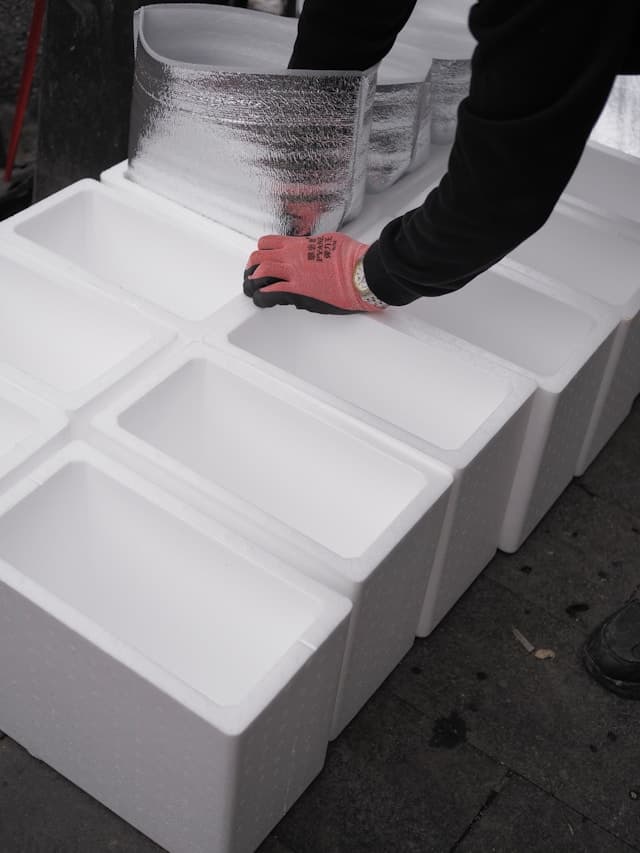
Technical guidance on maintaining temperature integrity for sensitive botanical extracts and standardised actives throughout the supply chain.
Sensitive botanical extracts — standardised plant actives, isolated phytochemicals, essential oils, and other temperature-labile natural-product ingredients — frequently require temperature-controlled handling that ordinary commodity ingredients do not. The published guidance is well-established; the gap is usually execution.
The regulatory baseline
The cold-chain expectations that apply to regulated medicines also provide the de facto technical baseline for sensitive ingredient transport. Several international frameworks define what good looks like:
- USP General Chapter <1079> — the primary US technical reference for temperature control, monitoring, and Mean Kinetic Temperature (MKT) calculations [1].
- EU Good Distribution Practice Guidelines (2013/C 343/01) — the European framework governing transport and storage conditions and supply-chain traceability [2].
- WHO Technical Report Series No. 961, Annex 9 — Model guidance for the storage and transport of time- and temperature-sensitive products [3].
- ICH Q1A(R2) Stability Testing — establishes the climatic zones and stability conditions referenced across international stability practice.
Defining the right temperature regime
Temperature ranges are conventionally defined in USP General Chapter <659> "Packaging and Storage Requirements":
- Frozen: typically −20°C to −10°C (or colder for specific products).
- Refrigerated: 2°C to 8°C.
- Cool: 8°C to 15°C.
- Controlled room temperature: 20°C to 25°C, with excursions permitted between 15°C and 30°C provided the MKT does not exceed 25°C.
The correct regime for a sensitive botanical extract is established by stability studies on that specific material — there is no industry-standard answer. Stability programmes following ICH Q1A(R2) determine label storage conditions, and the supply chain must hold the label conditions through every handoff.
Monitoring: continuous, calibrated, audited
GDP guidelines recommend continuous temperature monitoring with recordings at least every 15 minutes for storage, and at appropriate intervals during transport, with some regulations requiring more frequent recording for critical products [2][4].
Three practical disciplines separate competent cold-chain operators from problematic ones:
1. Calibrated devices, not consumer-grade dataloggers
NIST-traceable calibration certificates with documented re-calibration intervals are baseline. Devices that fall out of calibration silently are worse than no monitoring at all — they produce defensible-looking records that are wrong.
2. Mean Kinetic Temperature, not just min/max
MKT (defined in USP <1079>) accounts for the cumulative effect of temperature variation on chemical stability. A shipment that touches 30°C briefly is different from one that sits at 28°C for hours — MKT captures the difference, raw min/max does not [1].
3. Documented excursion protocols
When a temperature excursion is detected, the question is not "did it happen?" but "what is the documented response?" Pre-approved excursion management procedures — who is notified, who assesses product impact, who decides quarantine or release — turn a potential quality event into a routine operational response.
Common failure modes in botanical-extract cold chain
In our experience and across published industry analyses, the failures concentrate in predictable places:
- Tarmac dwell at airports — temperature-controlled containers staged in direct sun for hours before loading. Mitigation: insist on shaded staging or active-cooled containers with documented dwell-time limits.
- Last-mile transfer in non-refrigerated vehicles — material moves correctly through ocean and air, then sits in an ambient van for the final 4-hour drop. Mitigation: cold-chain validation through to the receiving dock, not just the destination port.
- Receiving without continuous monitoring — datalogger reads OK at arrival but no record of conditions between origin and destination. Mitigation: data must be captured end-to-end, not sampled at handoff points.
- Storage conditions at receiving facility — material arrives in spec but is held in a non-validated warehouse zone for days before use. Mitigation: receiving-area temperature mapping and validated storage zones for cold-chain material.
- Excursion management theatre — protocols exist on paper but are not followed in practice. Mitigation: tabletop excursion drills annually with cross-functional teams.
The simple, expensive truth
Validated cold chain costs more than ambient supply chain. The cost is in calibrated devices, validated containers, trained handlers, audited carriers, and documented quality systems. The premium is real, and it is what separates a botanical-extract supply chain that produces consistent assay results from one that produces lot-to-lot variability traced back to thermal damage that no one captured because no one was looking.
For buyers of sensitive botanical extracts and standardised actives, the procurement question to ask is not "do you have cold chain?" but "show me your USP <1079>-aligned procedures, your last calibration certificate, and your last documented excursion." The answers tell you more than any quote can.
- [1]USP General Chapter <1079> — Risks and Mitigation Strategies for the Storage and Transportation of Finished Drug Products
- [2]European Commission — EU Good Distribution Practice (GDP) Guidelines 2013/C 343/01
- [3]WHO Technical Report Series, No. 961, Annex 9 — Model guidance for the storage and transport of time- and temperature-sensitive pharmaceutical products
- [4]USP — Guidelines for Temperature Control of Drug Products During Storage and Transportation
- [5]Rx-360 / USP — Good Distribution Practice (GDP) Training Materials